 English (US)


Crypto Exchange Marketing: Effective Crypto Marketing Strategies
Because of this level of competition, acquiring new users through paid channels often comes at a high cost, and the return on investment isn’t always immediate. At the same time, retention becomes just as important as acquisition. Without a steady base of active, returning users, an exchange simply can’t sustain liquidity or long-term growth.
In this article, we’ll walk through the most effective crypto digital marketing channels for exchanges, explain how to identify and reach the right audience, and compare paid and organic promotion strategies that actually deliver results. We also take a closer look at content marketing crypto strategies that help exchanges stand out from competitors by highlighting trust, usability, and real product advantages.
This guide is relevant for centralized and decentralized exchanges, crypto wallets with built-in swap functionality and fintech platforms.
What Is Crypto Marketing and Why It’s Different
At its core, marketing is about driving traffic and converting it into revenue. However, crypto exchange marketing operates under very different conditions compared to traditional digital marketing.
Because Web3 products deal directly with financial risk, brand trust and reputation become central goals. In crypto exchange marketing, most campaigns are built around proving security, regulatory awareness, reliability, and ease of use — not just attractive offers.
Like any other business, exchanges aim to acquire new users and retain existing ones. But the way these goals are achieved is shaped by three key factors:
Regulatory restrictions
In many countries, crypto advertising is either heavily restricted or almost entirely banned. For example, in China and Algeria, promoting crypto services is nearly impossible. In the EU, advertising is allowed only with mandatory risk disclaimers. Even in the United States — often seen as relatively crypto-friendly — certain services are blocked or restricted at the state level. We’ve covered this in more detail in our analysis of the U.S. crypto market.
As a result, crypto marketers have to operate within a complex legal framework: understanding local regulations, navigating compliance requirements, and constantly looking for ways to promote products legally without putting the business at risk.
Liquidity requirements
For exchanges, marketing isn’t limited by regulation alone — liquidity plays an equally critical role. Growth must always match the available depth of trading.
Aggressive marketing campaigns, especially those driven by large volumes of paid traffic, can bring in users faster than liquidity can scale. When that happens, rates worsen, execution suffers, and the overall user experience declines. Once a user encounters poor pricing or slippage, winning them back becomes extremely difficult.
That’s why exchanges can’t afford to acquire users “at any cost.” Every new user increases the load on liquidity and infrastructure. This creates a delicate balance — and marketing can only work effectively when it’s closely aligned with the product’s real capabilities, market conditions, and operational capacity.
Extremely high competition
The global crypto exchange market is crowded. More than 500 active platforms worldwide are competing for the same users and liquidity. Even the top 10 centralized exchanges together capture only part of the total trading volume, rather than fully dominating the market.
Binance leads with roughly 35.9% market share, while the remaining 60% is split across a large number of competitors, all fighting for visibility, relevance, and growth in an increasingly saturated ecosystem.
At the same time, overall trading activity remains massive. In the first half of 2025, exchanges processed over $9.3 trillion in trading volume, highlighting just how intense the competition is — not only for users, but for capital and attention as well.
Defining Goals and Audience Before You Start Marketing
Before building a crypto marketing plan, it’s essential to clearly define your business objectives. We recommend focusing on goals that support long-term, sustainable growth.
Business Goals of a Crypto Exchange
Brand awareness and community building
Strong communities become organic growth engines. Active users provide liquidity, feedback, and advocacy, creating a powerful network effect.Product or token adoption
Marketing should convert interest into real usage.- For exchanges: higher trading volumes
- For DeFi protocols: increased TVL
- For stablecoins: more transactions and merchant adoption
For B2B crypto marketing, the strategy changes significantly. Here, the primary goal is to attract businesses that want to monetize traffic or integrate crypto functionality into their own products.
Crypto Exchange Target Audiences
The next step is understanding who your users are and what problems they are trying to solve.
First-time crypto users
New entrants to crypto who prioritize simplicity, clarity, and guidance over advanced functionality. For this group, ease of onboarding, intuitive interfaces, and clear explanations matter more than trading depth or complex features.
Experienced traders
High-volume users looking for advanced tools, low fees, and deep liquidity. They value speed, reliability, and complex order types.
Retail investors
New or casual users focused on simple buying and selling. For them, security, customer support, and educational content matter more than advanced trading features.
Institutional clients
Professional trading firms and financial institutions that require enterprise-grade security, regulatory compliance, and deep liquidity for large transactions.
Geographic segments
Different regions have their own regulations, payment preferences, and trading behavior. Localized marketing is often essential.
For example, Changelly may suspend or deny services at its discretion, including for residents of the United States and its territories, which makes the platform unavailable for many US-based users. At the same time, ChangeNOW allows US residents to swap crypto after creating an account and accepting its terms and conditions. For users in the US, this distinction often becomes a deciding factor — especially for those actively searching for crypto exchanges that can be used without complex verification requirements.
Understanding these segments allows you to adapt your crypto marketing strategy so that messaging resonates, builds trust, and encourages real usage. For example, institutional-focused platforms emphasize compliance and scalability, while retail-focused exchanges highlight simplicity and UX.
Proven Crypto Marketing Channels for Exchanges
Once the audience is defined, the next step is choosing the right channels. In crypto, specialized and niche channels often outperform broad-reach platforms due to higher relevance and conversion rates.
Сrypto Digital Marketing
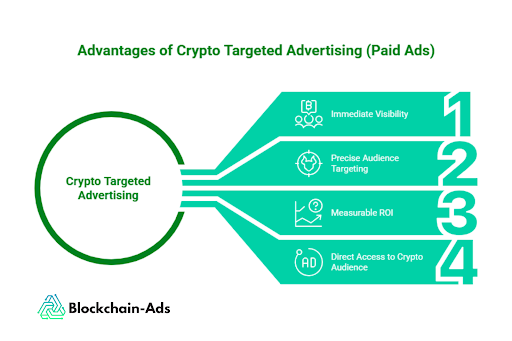
Despite restrictions on financial advertising, platforms like Google Ads, Meta, and Blockchain-Ads still offer targeted options for crypto promotion.
Key benefits
- Immediate visibility within crypto-focused audiences
- Precise targeting based on interests and behavior
- Measurable ROI with real-time conversion tracking
Drawbacks
Crypto digital marketing is restricted or banned in some countries, and accounts may be suspended if messaging violates policies. Legal review and compliant creatives are critical.
Content Marketing for Crypto Exchanges
Crypto content marketing and SEO are among the most sustainable growth channels in the industry. They focus on education, transparency, and long-term trust.
Content formats include
- Blog posts and long-form articles
- Educational videos and tutorials
- Podcasts and webinars
- Product guides and explainers
SEO ensures that this content ranks in search engines, helping users organically discover your exchange.
Step-by-step crypto SEO approach
- Keyword research based on real user intent
- High-quality, expert-level content
- On-page SEO optimization
- Backlinks from reputable crypto sources
- Regular updates aligned with market trends
SEO and content marketing typically take 6+ months to show significant results.
Social Media and Community Marketing
As mentioned earlier, it’s better not to try to cover every possible channel, but instead focus on the platforms where most of your target audience is already active. The crypto community doesn’t just use certain social networks — these platforms host tightly knit crypto communities, influential ambassadors, and even interface features that actively support the promotion of crypto products. In this context, we are primarily talking about the following channels:
X (Twitter)
Use X for real-time market updates and news sharing. The platform’s interface makes it easy to actively interact with partners, launch collaborations, and run giveaways. It’s also an ideal space for hosting AMA sessions, which help draw attention to the product and create a closer connection with the audience through live, open dialogue where users can ask questions directly.
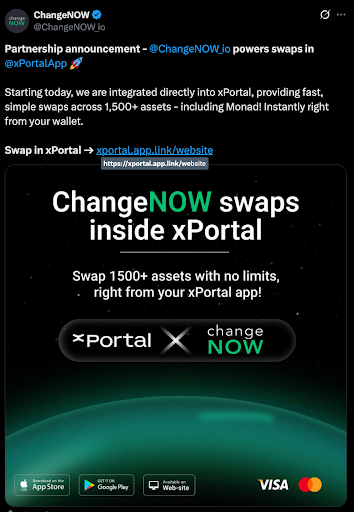
Example: a partnership post between the ChangeNOW crypto exchange and the xPortal wallet.
Collaboration had started to improve swap rates for users and increase overall swap efficiency. That leads to social reach over 27 000 +, smooth integration between partners and increased swap activity and stronger performance metrics.
Telegram
Use Telegram to engage directly with your community through chat discussions and to publish exclusive announcements in your channel.

Example: Onto Wallet uses Telegram to announce exclusive giveaways for wallet users.
Discord
Discord is well suited for building more structured communities, providing ongoing support, hosting discussions, and maintaining closer relationships with your most active users.
Use Reddit for educational content and deeper, more meaningful interaction with the crypto community. Reddit allows for long-form discussions, detailed explanations, and authentic feedback from experienced users.
Youtube
Use video platforms for educational content, partner videos, and podcasts. Long-form videos typically generate higher engagement among your target audience, while publishing Shorts helps expand reach and attract new users.
An example of educational content at ChangeNOW Youtube channel
Social Media Strategy Approach
Focus on delivering value through educational content and responsive customer support, rather than relying solely on promotional messaging. A well-balanced strategy often follows the classic ratio:
- 33% educational content
- 33% entertaining content
- 33% promotional content
To identify strong content directions, start by mapping out your audience’s pain points and creating a dedicated content category for each one. For example:
| Audience Pain Point | Content Category |
|---|---|
| “All crypto exchanges are unreliable — I’ve already been tricked by hidden fees before.” | Publishing TrustPilot reviews where users highlight the platform’s reliability and transparency. |
| “I’ve been using the same exchange for years and the interface feels outdated. But I'm too lazy to switch” | Cash or token giveaways for new exchange users to motivate them to try our exchange. |
| “I don’t understand how to use your exchange — the UX feels unfamiliar.” | Educational videos that clearly and simply explain each step of the user journey. |
Public Relations and Media Coverage
Strategic public relations efforts help build trust and attract organic traffic through coverage in crypto publications and financial media outlets.
When selecting a pool of media to work with, base your decision on data such as:
- traffic volume
- domain rating / domain authority
- publication focus and editorial topics
- cost-to-traffic ratio
- overall credibility and reputation of the outlet
As relationships with journalists and editors develop, you will gain opportunities beyond press releases and paid placements. These include publishing expert opinions from your company’s speakers, commenting on major crypto industry news, and receiving exclusive media placement offers at more favorable rates.
Email Marketing
Email marketing allows you to stay connected with users by informing them about new features, trading opportunities, and exclusive offers.
Segmentation strategy: Segment your mailing lists based on user behavior, preferred cryptocurrencies, and engagement levels. This enables you to deliver personalized content that resonates with different user groups.
Content types: Share platform updates, market insights, educational materials, and exclusive promotions that consistently deliver value and encourage more active use of the platform.

An example of Binance email marketing
Referral Programs
Many of your loyal users are likely satisfied with your crypto exchange. However, they may not actively recommend it to others. In most cases, they simply need a small incentive — such as a reward for encouraging friends or colleagues to join.
This is exactly why referral programs are essential: they allow you to reward users who help grow your customer base.
Offer a fixed reward for each successful referral, provide users with unique referral links, and clearly define the terms and conditions. Promote the referral program through your other marketing channels, and results will follow.
In one of our previous articles, we talked about 9 affiliate programs that can help you earn passive crypto income.
Conference & Event Marketing
Event marketing is arguably the most resource-intensive and unpredictable channel for crypto services. However, it can generate warm leads immediately and lay the groundwork for long-term partnerships.
Popular event formats include participation in industry conferences, hosting your own events, and organizing side events for a selected group of partners — such as business breakfasts, meetups, or cocktail receptions.
Key benefits of events
- Networking opportunities
- Increased brand awareness
- Partner-driven initiatives
- Creation of newsworthy moments for media coverage
Drawbacks: High costs, including expenses for external contractors or an in-house team responsible for event organization.
Partnerships
Partnerships refer to various collaboration models that allow companies to combine their strengths — for example, leveraging the traffic of one service and the technical capabilities of another to jointly monetize that traffic.
Explore B2B partnership opportunities with ChangeNOW. We offer a comprehensive approach and a set of flexible tools designed to meet the needs of businesses of all types — from crypto projects and wallets to fintech platforms and crypto exchange services similar to our own.
Marketing Costs and ROI Overview
| Crypto Marketing Strategies | Budget Range/Month | ROI |
|---|---|---|
| 1. Targeted Advertising | $20K - $200K | 3-8x |
| 2. PR & Media | $20K - $150K | 2-4x |
| 3. Social Media | $15K - $100K | 2-5x |
| 4. Content & SEO | $15K - $80K | 4-8x |
| 5. Token Incentives | $50K - $500K | 2-5x |
| 6. Influencer Partnerships | $30K - $250K | 3-6x |
| 7. Email Marketing | $10K - $50K | 4-10x |
| 8. Referral Programs | $20K - $100K | 3-7x |
| 9. Events | $50K - $500K | 1.5-3x |
| 10. Project Partnerships | $25K - $200K | 2-4x |
Key Success Metrics
Effective crypto exchange marketing relies on tracking:
| KPI | Definition | Benchmark | Importance |
|---|---|---|---|
| Customer Acquisition Cost | Total cost to acquire a new customer | $15–$50 for crypto exchanges | High |
| Retention Rate | Percentage of users retained over time | 30-40% after 6 months | Essential for long-term growth |
| Daily Active Users (DAU) | Number of users active daily | Varies based on exchange size | Indicates daily engagement and usage |
| Conversion Rate | Percentage of visitors becoming users | 3.5% for exchanges with high traffic | Measures effectiveness of marketing |
Examples of Successful Crypto Growth Marketing for Exchanges
Case 1: Wallet + Exchange Integration
Wallets that integrate built-in swaps reduce friction and increase transaction volume without forcing users to leave the app.
Case 2: Content-First Growth
Exchanges investing in educational SEO content consistently outperform competitors relying only on paid traffic.
Case 3: Partnerships as Growth Engines
Cross-product partnerships allow exchanges to access high-intent traffic while sharing revenue instead of burning ad budgets.
TOP 5 Common Crypto Exchange Marketing Mistakes
- Overpromising ROI
- Ignoring liquidity realities
- Chasing traffic instead of active traders
- No analytics or cohort analysis
- Choosing channels without audience research
There is no single “most popular crypto marketing strategy” — this is a myth. Sustainable growth always comes from a balanced system.
Conclusion: how to promote crypto offers
Crypto exchange marketing is a system, not a single channel.
The strongest results come from products with solid infrastructure, deep liquidity, and seamless integrations.
True growth comes from trust, performance, and long-term partnerships — not hype-driven campaigns.
Exchanges that focus on execution quality, liquidity, and real user value scale faster than those relying on short-term marketing noise.